
The approval button is the easy part
An AI system prepares a decision. A person sees an approval screen. They click Confirm.
From a distance, this looks like human oversight.
Look closer and the person may have no idea which data the system used, which alternatives it rejected, or what happens after approval. The queue may contain 200 near-identical items. The reviewer may be measured on speed. Rejecting may create more work, while approving takes one click.
The human is present, but their judgment is mostly decorative.
This is where many “human in the loop” designs go wrong. They add a person to the process without designing a useful role for that person.
Meaningful oversight requires more than visibility. The reviewer needs enough context to notice a problem, enough time and skill to judge it, enough authority to act, and a control that genuinely changes what the system will do.
That combination matters more as AI moves from generating suggestions to making recommendations, prioritising cases, using tools, and acting across other systems.
The EU AI Act makes a similar distinction for high-risk AI systems. Article 14 says oversight measures should be proportionate to the risk, autonomy, and context of use. The people assigned to oversight should be able to understand the system’s capabilities and limits, remain aware of automation bias, interpret output, decide not to use it, override it, or interrupt the system when needed. EUR-Lex, Regulation (EU) 2024/1689, Article 14
That is a regulatory requirement for a defined set of systems, not a universal UI specification. Still, it provides a useful design test: can the person responsible for oversight actually prevent or reduce harm?
This guide offers 20 patterns for making that possible. They cover role design, review placement, approval interfaces, live intervention, escalation, and the operational work that keeps oversight useful after launch.
What makes oversight meaningful
I find it useful to define meaningful oversight through five conditions.
The reviewer can see
They can inspect the proposed action, relevant evidence, important uncertainty, affected people, and the system’s current state.
Seeing does not mean exposing every model detail. It means showing the information needed for the decision at hand.
The reviewer can understand
They know what the system is doing, what it is not qualified to decide, and why this case requires attention.
An unexplained score or a long activity log rarely meets that standard.
The reviewer can judge
They have the right domain knowledge, policy context, and time. The task is small enough to assess without reconstructing the whole workflow.
The reviewer can act
They can approve, reject, edit, narrow, pause, stop, escalate, or take over. The available action should match the risk.
The organisation responds
The decision is recorded, the system follows it, repeated problems reach the right team, and the reviewer is not punished for slowing down unsafe work.
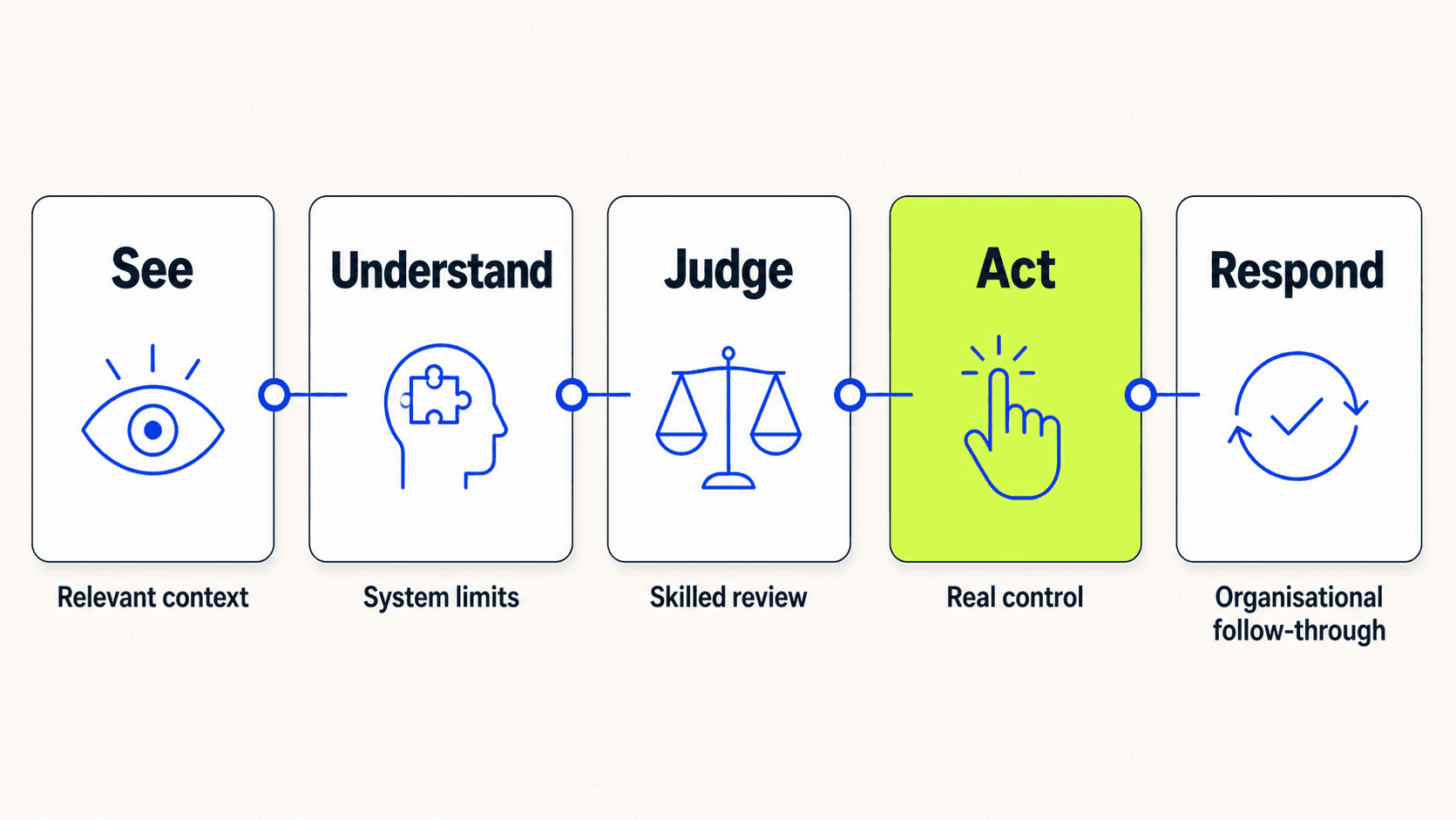
Visibility is only one part of oversight. Judgment and authority matter just as much.
Remove any one of these conditions and the loop weakens. A skilled reviewer without authority becomes an observer. A powerful reviewer without context becomes a guesser. A clear interface inside a workplace that rewards automatic approval becomes theatre.
NIST’s AI Risk Management Framework treats human roles as part of the wider system. It calls for clear responsibilities in human-AI configurations, documented oversight processes, operator proficiency, and ongoing monitoring rather than a one-time control at launch. NIST, AI RMF Core
The design therefore begins before the approval screen.
Choose the Right Human Role
“Human in the loop” hides several different jobs. The first step is deciding what the person is responsible for.
Pattern 01 · Observer
The observer watches system behaviour and receives status, anomaly, or incident information. They do not approve every action.
This role fits lower-risk activity where continuous visibility matters more than individual review. The interface should make trends, boundary breaches, and unusual events easy to spot.
Observation is not enough when a single action can cause serious or irreversible harm.
Pattern 02 · Reviewer
The reviewer evaluates an output before another person or system relies on it. They may edit, accept, or reject it.
This role is common for generated content, analysis, classification, and recommendations. The review surface should show the source material and the proposed output together, with changes made directly in context.
Pattern 03 · Approver
The approver authorises a consequential action: sending, publishing, paying, deleting, changing access, or updating an official record.
Approval should be reserved for meaningful commitment points. If every minor step requires approval, the signal disappears inside routine clicking.
Pattern 04 · Supervisor
The supervisor monitors a running process and can redirect, pause, or stop it. They are responsible for the course of the work, not only the final result.
This role matters for long-running agents, live operations, and work that can change direction as new information appears.
Pattern 05 · Escalation owner
The escalation owner handles cases outside the normal rules: high impact, conflicting evidence, policy ambiguity, repeated failure, or suspected attack.
They need access to deeper context and a clear route to specialists. Escalation should not mean placing the same approval card in a more senior person’s queue.
Pattern 06 · Accountable owner
The accountable owner is responsible for how the AI system performs over time. They review metrics, incidents, policy changes, and whether the oversight model still fits the product.
This role may sit with a product, operations, risk, or service owner. It should be named. “The business” is not an accountable owner.

Different risks need different human roles. One approval queue cannot carry all of them.
These roles can belong to different people. A customer may review a draft, an operations specialist may supervise execution, and a governance owner may examine incidents across the service.
Trying to make one end user responsible for all three creates confusion and pushes organisational risk onto the person least able to manage it.
Put review where judgment can still matter
Oversight has to occur before the relevant outcome becomes difficult to change. That sounds obvious, yet products often ask for review after the work has already been sent, applied, or propagated.
The right checkpoint depends on impact, reversibility, uncertainty, novelty, and who else is affected.
Pattern 07 · Risk-based checkpoint
Require review when the consequence crosses a defined threshold.
Useful signals include:
money moved or committed
people contacted outside the current team
access or permissions changed
official records created or modified
sensitive data exposed or reused
a decision affecting rights, eligibility, safety, or employment
an action that is difficult to reverse
The threshold should come from product and policy work, not from the model deciding when it deserves supervision.
Pattern 08 · Uncertainty escalation
Escalate when important evidence is missing, conflicting, outside the system’s working range, or unusually ambiguous.
Do not reduce this to one confidence percentage. Model confidence may be poorly calibrated and can hide disagreement among sources. Show the reason for escalation: “Two policies conflict,” “No recent source was found,” or “The requested action is outside the normal account range.”
Pattern 09 · Novelty trigger
Ask for review when the system encounters a case that differs materially from previous approved work.
Novelty can include a new tool, new destination, new data category, new customer type, or unfamiliar workflow path. A task may be low value but still deserve attention because the system has not handled it before.
Pattern 10 · Random sampling
Review a changing sample of low-risk work rather than every item.
Sampling can reveal quiet drift without creating a permanent approval bottleneck. The sample should include ordinary cases as well as edge cases; reviewing only flagged work gives the team a distorted picture of normal performance.
Pattern 11 · Two-person verification
Use separate reviewers when the consequence justifies independent confirmation.
The second reviewer should receive an independent view, not a screen dominated by the first person’s answer. Otherwise the process can turn into rubber-stamping with two clicks instead of one.
The EU AI Act requires separate verification by at least two competent people for certain high-risk biometric identification uses, with stated exceptions. That is a specific legal rule, but the design principle travels: independence matters when confirmation is meant to reduce correlated error.
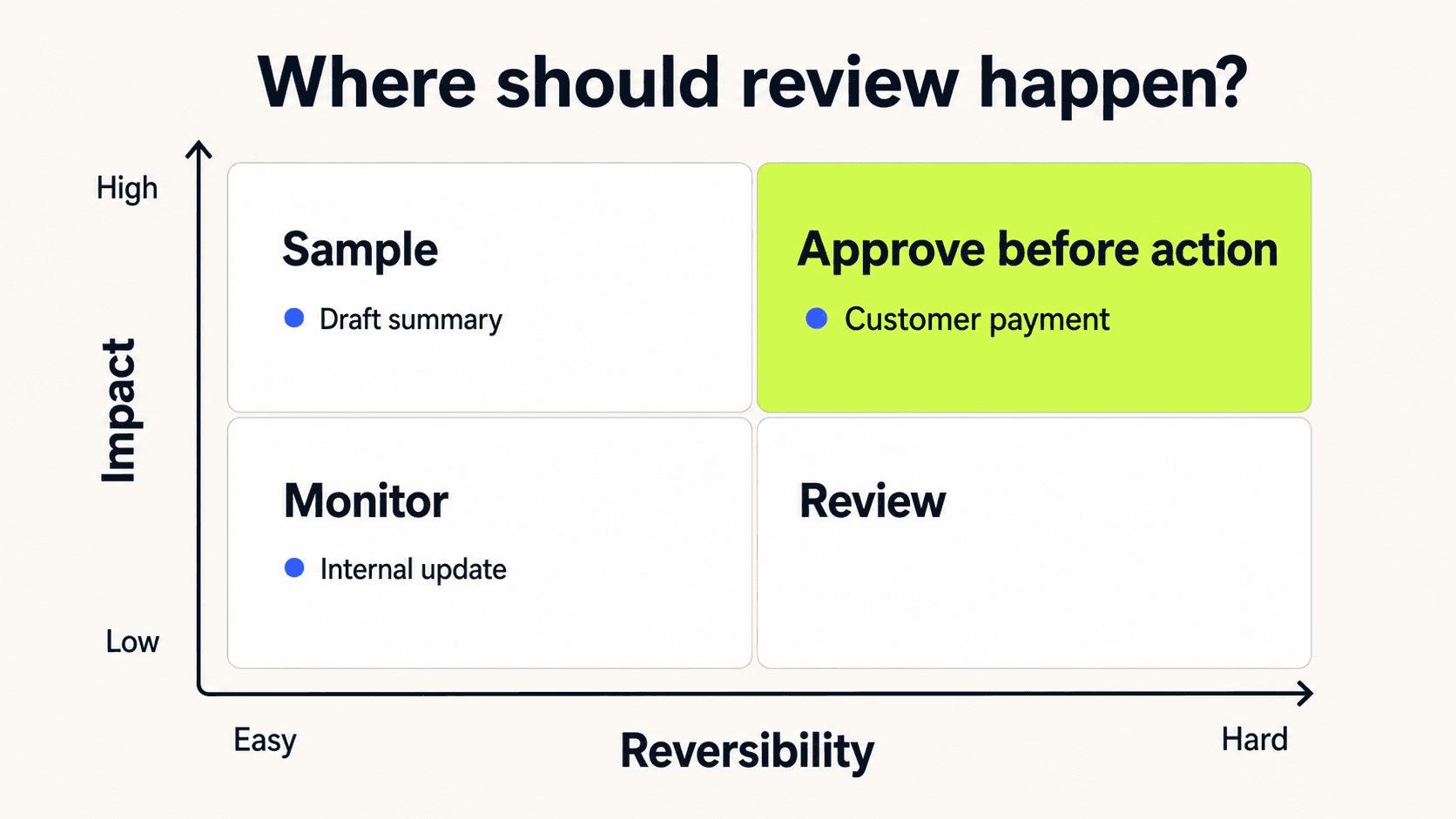
The strongest checkpoints sit before high-impact, hard-to-reverse actions.
Design the Review Moment
A good review interface helps a person reach a considered decision. It does not simply expose more information.
The reviewer should be able to answer five questions quickly:
What is the system proposing?
Why is this case here?
What evidence supports it?
What changes if I approve?
What can I do instead?
Pattern 12 · Decision brief
Summarise the proposed action in plain language at the top of the review.
Include the affected object or person, destination, timing, scope, and commitment. “Approve tool call” is not a decision brief. “Send renewal offer to 1,240 customers at 09:00 tomorrow” is.
Pattern 13 · Reason for review
Explain why human judgment is needed now.
Examples include high financial value, low evidence quality, policy conflict, first use of a tool, external recipient, or an unusual change in scope.
This helps the reviewer focus. It also prevents the system from treating all approvals as equal.
Pattern 14 · Evidence and provenance
Put the supporting evidence close to the proposed action. Show source, freshness, and relevant disagreements.
Do not bury the reviewer in raw logs. Start with the evidence that could change the decision and provide deeper inspection when needed.
Microsoft’s human-centred agent guidance recommends keeping outputs editable and showing the relevant files, selections, or data sources during interaction. Microsoft, Human-centered design for agents
Pattern 15 · Impact preview
Show the practical effect before approval.
For a message, show recipients and final copy. For a database change, show records added, edited, and removed. For a permission change, show who gains access. For a payment, show amount, account, fees, and whether cancellation is possible.
Impact preview turns an abstract system action into something a person can judge.
Pattern 16 · Balanced action set
Offer actions that support judgment, not only throughput.
Depending on the task, the reviewer may need:
Approve
Reject
Edit and approve
Request more evidence
Narrow the scope
Send to a specialist
Save as draft
Stop the workflow
The primary button should not automatically be the fastest or most permissive option. Visual emphasis should reflect the decision, not the product’s preference for completion.
Pattern 17 · Decision rationale
Capture a short reason when it will help later review, learning, or accountability.
Do not require a long comment for every routine approval. Use structured reasons for common cases and free text for exceptions. The rationale should travel with the action receipt and become available to the team analysing repeated problems.
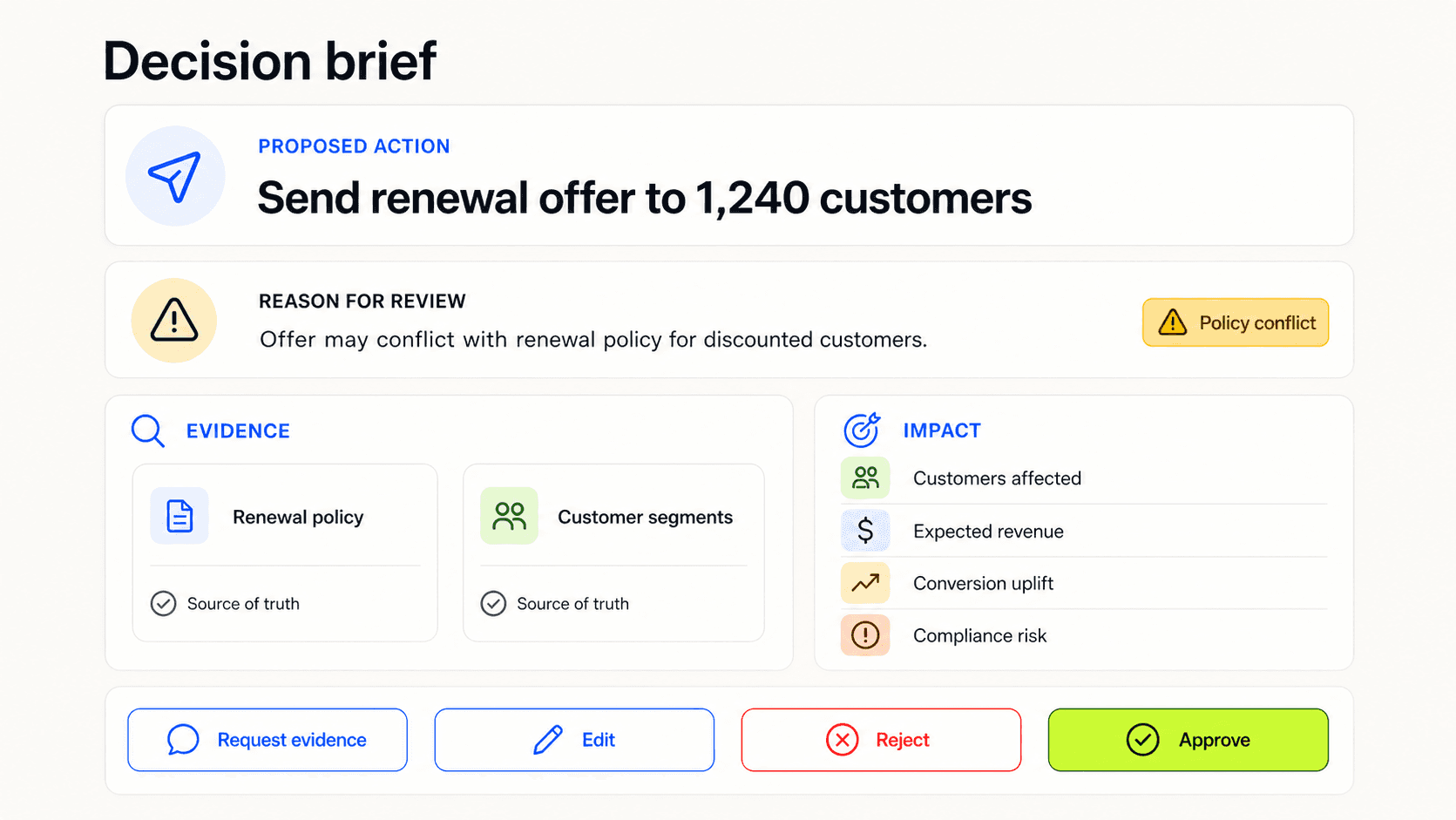
A review card should reduce the work required to make a good decision, not simply add friction.
Intervention and Operations
Support intervention during execution
Some work cannot be understood at a single checkpoint. A long-running agent may search, transform data, contact other systems, wait for responses, and adapt its plan.
Oversight needs a live mode as well as an approval mode.
Pattern 18 · Inspectable state
Show the current goal, completed work, active step, next planned action, and any unresolved exception.
Avoid narrating every internal thought. The reviewer needs operational state: what the system has done, what it is doing, what it will do next, and what changed from the approved plan.
Pattern 19 · Reliable interruption
Provide pause and stop controls that work at the system level.
The control needs a clear promise. Pause may prevent new actions while allowing the current safe operation to finish. Stop may cancel pending work and block further tool calls. Explain which one applies.
Microsoft’s guidance for reducing agentic risk recommends reliable system-level mechanisms to pause or stop agents, alongside deterministic controls that block prohibited actions regardless of model output. Microsoft, Reduce autonomous agentic AI risk
Pattern 20 · Takeover with handback
Let a person take direct control of the task, fix the specific problem, and return the remaining work to the system.
The handoff should preserve context. The reviewer should not have to reconstruct the task from a transcript, and the agent should not overwrite the manual correction when it resumes.

Live oversight makes the system interruptible without forcing the person to restart the work.
Intervention also needs a path when the normal interface fails. High-impact systems should not rely on the same AI workflow to interpret the request to stop itself.
Make oversight operational
The interface can create a good decision moment and still fail in practice if nobody owns the queue, reviewers are overloaded, or the organisation rewards speed over care.
Meaningful oversight is a service operation.
Reviewer competence
Define what the reviewer needs to know. That may include domain knowledge, local policy, system limits, security signals, accessibility, or the rights of affected people.
Training should use realistic cases, including disagreements with the AI. A reviewer who has only seen correct outputs may learn to trust the system precisely when they should remain critical.
Reviewer authority
Make it safe to reject, pause, and escalate. If those actions harm performance ratings or create unmanageable follow-up work, the interface will not correct the incentive.
Authority also means access to someone who can resolve policy ambiguity. “Contact support” is weak when the reviewer is making a time-sensitive, high-impact decision.
Queue design
Prioritise by impact, deadline, uncertainty, and time waiting. Group similar low-risk items where batch review is genuinely safe, but keep unusual cases separate.
Show workload and expected review time. A queue that silently exceeds human capacity is an automation system with delayed approval, not oversight.
Separation of duties
Avoid giving one person control over proposing, approving, and auditing the same high-risk action when independence matters.
Separation can also apply to teams and agents. The system that generates a recommendation should not be the only system evaluating whether it is safe.
Incident and appeal routes
Create a path for users, reviewers, and affected people to report mistakes, challenge outcomes, and request human reconsideration.
Oversight is incomplete if the only person who can raise a problem is the person shown the original approval card.
Versioned policy
Record which rule, model, prompt, data source, and permission set applied to each decision. When policy changes, the team needs to know which earlier outcomes may need review.
NIST emphasises that roles, oversight processes, monitoring, and documentation should continue across the system lifecycle. A launch checklist cannot carry that responsibility alone.
Failure Modes and Measurement
Common oversight failure modes
Rubber-stamp review
Approval is faster and visually easier than disagreement. Reviewers learn that the queue expects confirmation rather than judgment.
Fix the incentive, action balance, and sampling model. A warning message will not solve it.
Context dumping
The interface shows every source, score, event, and model detail without deciding what helps the reviewer.
Use progressive disclosure. Lead with the decision, reason for review, strongest evidence, and material impact.
Approval fatigue
Too many low-value checkpoints make important ones feel routine.
Move safe repeated work to sampling, policy-based limits, or post-action monitoring. Preserve approval for decisions where a person can add judgment.
Review after commitment
The product asks for confirmation after a message has been sent, data has propagated, or another system has already acted.
Create a real draft-to-commit boundary.
Unqualified reviewer
The person is available but lacks the expertise or policy authority to judge the case.
Route by decision type, not merely by team membership or seniority.
Hidden automation bias
The AI recommendation arrives first, looks precise, and frames the evidence. The reviewer anchors on it even when alternatives exist.
For sensitive decisions, consider showing raw evidence or an independent assessment before revealing the system’s recommendation. NIST notes that human-AI configurations can amplify bias under some conditions, and that explanations are interpreted differently across people and skills. NIST, Human-AI Interaction
Stop that does not stop
The interface changes state, but queued actions, subagents, or connected tools continue.
Test interruption across the whole execution path. A control is only real if downstream behaviour obeys it.
Accountability without power
A person is named as responsible but cannot change the model, policy, permissions, staffing, or rollout.
Match accountability with decision rights and resources.
What to measure
Oversight success is not the number of approvals completed.
That metric can reward the very behaviour the control was meant to prevent.
Decision quality
Review whether approved, edited, rejected, and escalated cases produce better outcomes than appropriate baselines. Include delayed effects and downstream complaints where possible.
Intervention value
How often does human involvement materially improve the output, reduce scope, add evidence, prevent an unsafe action, or reveal a policy gap?
If review never changes anything, the system may be excellent, the checkpoint may be misplaced, or the reviewer may not have a real role. Investigate before removing the control.
Reviewer agreement
Measure where competent reviewers disagree and why. Disagreement can expose ambiguous policy, incomplete evidence, or a decision that should not be reduced to one automatic rule.
Approval and rejection time
Track time separately. Very fast approval and very slow rejection can reveal an interface or incentive that favours confirmation.
Escalation health
Monitor queue age, capacity, resolution time, repeated causes, and whether reviewers receive useful feedback after escalation.
Stop effectiveness
Test whether pause, stop, rollback, and takeover controls work under realistic load and partial failure. Record any downstream action that continues after the stop boundary.
Oversight coverage
Check whether every high-impact workflow has a named owner, defined reviewer role, intervention path, and incident route. Coverage should include new tools and new agent capabilities added after launch.
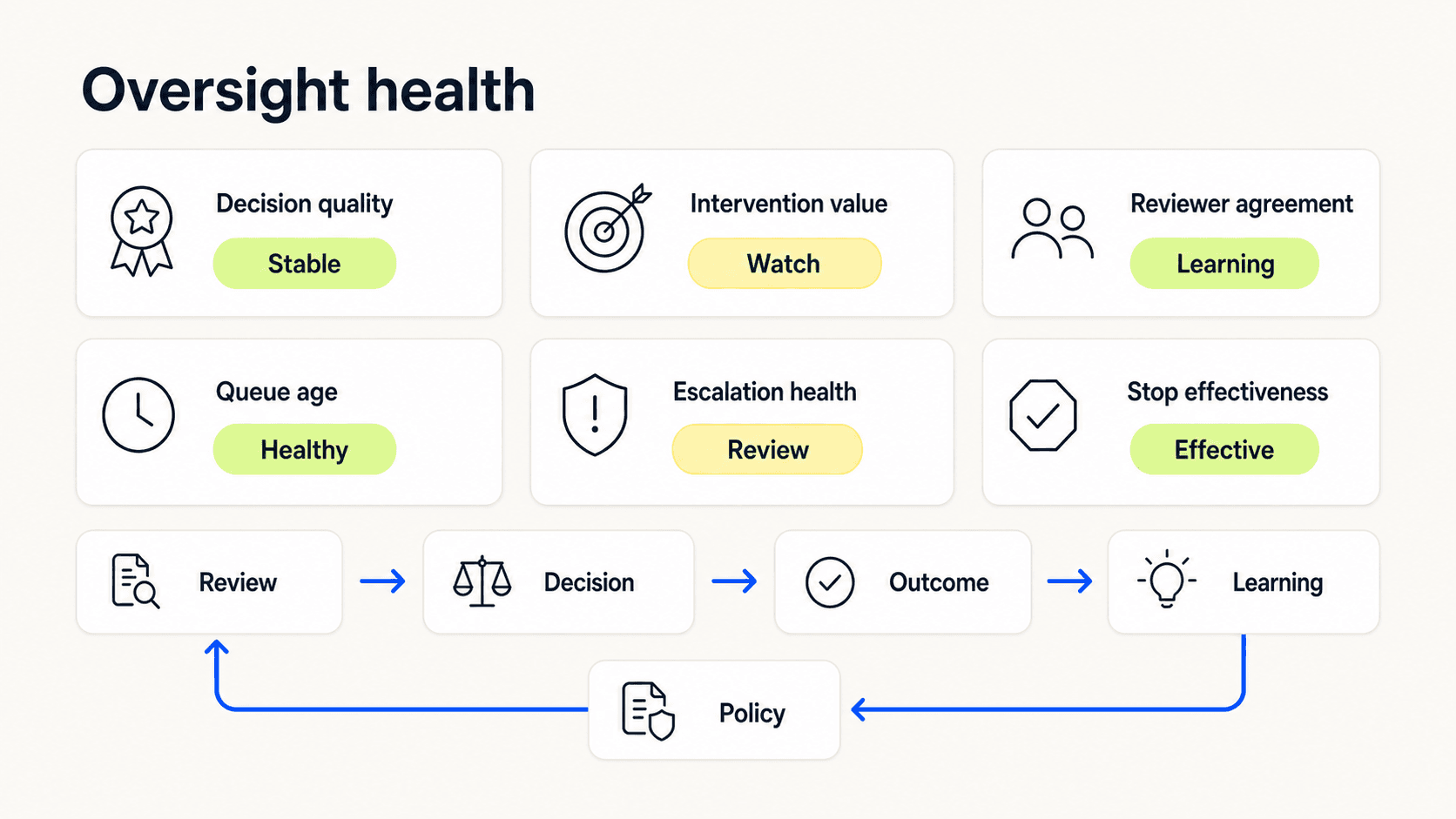
Measure whether oversight changes outcomes, not how quickly people approve.
A Practical Oversight Review
Use these questions while defining the workflow, critiquing the interface, and preparing for release.
Role
What specific judgment belongs to a person?
Is the person observing, reviewing, approving, supervising, escalating, or owning the system?
Do they have the competence, time, and authority required?
Is accountability matched with real decision rights?
Placement
Which actions are high impact or difficult to reverse?
Which uncertainty, novelty, or boundary signals trigger review?
Does review happen before commitment?
Can lower-risk work use sampling or monitoring instead of constant approval?
Review interface
Is the proposed action clear in plain language?
Does the reviewer know why the case needs attention?
Are evidence, provenance, disagreement, and freshness visible?
Is the practical impact shown before approval?
Are reject, edit, narrow, escalate, and stop actions genuinely available?
Live control
Can the reviewer see current and next state?
Do pause and stop have clear, tested semantics?
Can a person take over without losing context?
Can the system resume without undoing the manual correction?
Operations
Who owns the queue and its capacity?
How are urgent and unusual cases prioritised?
Is reviewer training based on realistic failure cases?
Can affected people challenge or appeal an outcome?
Are policy, model, data, and permission versions recorded?
Learning
Do reviewer decisions reach the product and policy teams?
Are repeated escalations treated as system problems rather than reviewer workload?
Does the team measure intervention value and stop effectiveness?
Is the oversight model reviewed when capability or context changes?
The Human Needs a Real Job
Human oversight is sometimes discussed as a brake on automation. That makes it sound like the person exists mainly to slow the system down.
A better design starts with the judgment the system cannot safely carry alone.
The person may understand a social context the data misses. They may weigh two legitimate values, recognise a policy exception, notice that an action is inappropriate despite being technically allowed, or accept responsibility for a decision that affects someone else.
That work needs space in the product.
Not every AI action needs approval. Some systems need monitoring. Some need random review. Some need an expert before commitment. Others should remain manual because the supposed handoff creates more risk than value.
There is no single correct loop.
The useful question is whether the human role changes the outcome when it matters. Can the person see, understand, judge, act, and get a response from the organisation?
If yes, the loop may deserve to be called oversight.
If not, the person is probably there to make the system look safer than it is.

