Midshift : Redefining Career Development with a Human-Centred AI Roadmap

01 · Introduction
Midshift set out to transform career growth by integrating mentorship, AI-driven roadmaps, and an LMS
In October 2023, Midshift was set out to accelerate career growth through mentorship and complementary services. However, user research uncovered a significant market gap, leading to the AI-generated roadmap becoming the platform’s core service.
My role
As Product Designer, I owned product scoping, user research, user flows, wireframing, rapid prototyping and usability testing.
I also facilitated cross-functional workshops and synthesised research into viable product decisions.
Team
1 Product designer
1 UX designer
1 Full stack developer
1 ML Engineer
1 Product manager
1 Marketing specialist
Tools
Figma, Miro, Jira, Lookback, Bolt.new
Duration
8 weeks
02 · Understanding the Problem
Users Craved Clear Guidance: Why Mentorship Alone Misses the Mark
Career development platforms often left users feeling lost and confused. Mentees found it hard to choose the right mentors, often unsure about how to connect or what to expect. Mentors, on the other hand, struggled to offer tailored advice without spending a lot of time getting to know each mentee’s specific situation. This whole process feels disorganised and ineffective for both sides, which raised this question for us:
HMW
simplify career guidance for both mentors and mentees so that the process feels more personalised and effective?

03 · Our Solution
A personalised career roadmap to simplify guidance, enhance mentorship, and support your growth.
Shape your future with a roadmap that grows with you.
Personalise Roadmap Generation
Tailored career plans, crafted just for you.
Train AI using updated senior professional CVs to design informed, realistic paths. Analyse your tech and soft skills to build a step-by-step roadmap for career growth. Visualise your journey with interactive tools that show clear progression and milestones.
Select the visual to view it at full size.
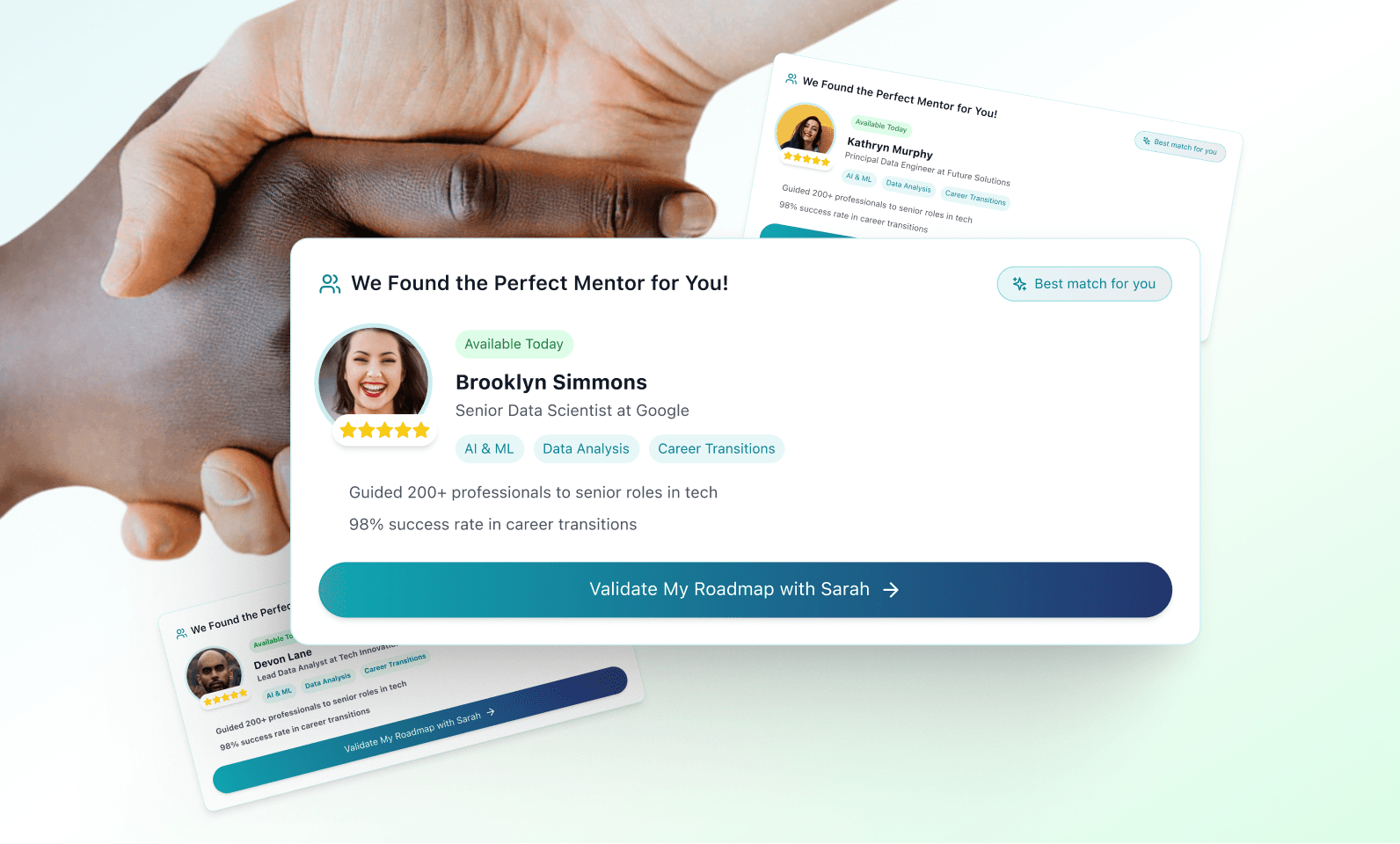
Mentor Matching
The right guidance, from the right people.
Match with mentors based on your target role, industry, personality, and roadmap needs. Benefit from career coaches who provide customised advice and continuous support. Build meaningful mentor relationships that align with your career aspirations.
Select the visual to view it at full size.
Integration of Learning Resources
All the tools you need, in one place.
Access courses from top platforms, currently integrated with Coursera. Discover curated articles, books, and materials relevant to your field and goals. Stay updated with the latest resources to accelerate your learning and growth.
Select the visual to view it at full size.
04 · Research and Identifying the Need
Interviews and analysis exposed gaps in mentorship, guiding the creation of a user-focused career roadmap.
Our stakeholder interviews revealed key challenges for mid-level professionals seeking efficient paths to senior roles: finding aligned mentors, fitting skill development into busy schedules, and needing flexible career planning. Existing solutions—from traditional education to self-learning platforms—often lack personalisation, sustained feedback, and structured support. These gaps reinforced our vision for an AI-driven mentorship platform that tailors guidance, addresses evolving skill needs, and accelerates professional growth.

Desk research
Reviewed career-development, education and mentoring behaviour to understand the broader problem space.
Market research
Compared how existing platforms connect mentors, structure learning and support career progression.
Primary research
Interviewed approximately 20 mentees and 10 mentors, then synthesised recurring needs and tensions.
Analysing Market & Competitions
Analysis exposed inefficient tools in current platforms, reinforcing the need for a streamlined solution.
Once the direction was set, I conducted a competitive analysis to understand market solutions and their functionality. Existing mentorship platforms were resource-heavy and lacked efficient mentor–mentee connection tools. We hypothesised that a career roadmap could reduce mentees’ uncertainty, reduce mentors’ repeated discovery work and create a clearer value proposition for Midshift.

SWOT synthesis
The synthesis separated what current services did well from the resource-heavy onboarding, generic roadmaps and weak progress loops that created an opportunity for Midshift.

SWOT artefact. Select to inspect the detail at full size.
05 · Validating Our Assumptions
Mentees and mentors described the same underlying problem from opposite sides.
Mentees struggled to choose the right mentor, prioritise skills and understand the next useful step. Mentors wanted to give relevant guidance without spending the beginning of every relationship reconstructing the person’s context and progress.

“I’ve been stuck in the same role for years because I don’t know which skills to prioritise. A clear roadmap would really help me focus and move forward.”
Samantha · Mid-level Marketing Specialist
“Tracking my mentees’ progress is tough. I want a simple way to see how they’re growing so I can tailor my advice and feel more confident as a mentor.”
Maria · Senior UX Designer
“I’m overwhelmed by online resources. I need a mentor who can point me to what’s actually relevant for my career goals.”
Jerad · Software Developer
“Balancing mentoring sessions with my own workload is challenging. A platform that helps me notice mentees’ desired career path early would reduce my stress.”
Saba · Data Science Mentor
Personas made the shared context problem concrete.
Although new mentees often begin with optimism, many quickly lose direction without clear milestones or structured feedback. A lack of tangible progress can make mentees question whether they’re moving closer to—or further from—their career aspirations.

Mentee · David
27 · Mid-level professional · Ambitious
His goal is to accelerate his career path into a top-tier position. He needs structured guidance, real-time feedback and effective ways to close skill gaps while juggling work commitments.
“I’m excited about a new role, but I’m not sure which skills to work on first—or whether they’ll actually help me land the job.”

Mentor · Sarah
35 · Full-time mentor · Design-focused
Her goal is to provide impactful, personalised mentorship while tracking her own professional growth. She needs a streamlined system to measure mentees’ progress, refine her mentoring strategies and balance her busy schedule effectively.
“I’m eager to guide more aspiring professionals, but I’m stretched thin trying to balance everyone’s unique goals and track their progress in real time.”
Journey mapping exposed where momentum disappeared.
For mentees, the focus was bridging skill gaps and accessing the right mentorship. For mentors, it was providing structured guidance while effectively tracking progress and growth.

Mentee journey. Select to inspect at full size.

Mentor journey. Select to inspect at full size.
Low clarity and support derail progress.
New mentees often begin with optimism but lose direction without clear milestones or structured feedback. The experience needed visible progress, time-bound goals and a clear personal payoff to compete with busy schedules.
Progress isn’t always visible
Without consistent checkpoints or measurable progress indicators, motivation fades and people become unsure of their actual growth.
No deadlines, no progress
Without time-bound goals or reminders, skill-building and mentoring sessions are easily pushed from next week to next month—or abandoned.
A personal payoff drives engagement
Both sides have limited time. Linking the experience to an immediate career goal makes continued participation worthwhile.
06 · From Insights to Actionable AI Solutions
A key part of the process was aligning business goals with user needs.
We analysed the needs revealed by research, then collaborated with stakeholders, the ML engineer and technical leadership to identify where an AI-generated roadmap and mentorship could create value without ignoring startup constraints.
Business
Create a sustainable product proposition, establish authority, understand ROI and move beyond resource-heavy one-to-one services.
Market
Respond to industry-specific skill gaps, changing job tenures, rising leadership expectations and demand for soft skills.
Product
Combine adaptive roadmaps, mentor matching, learning resources, contextual modules and meaningful progress data.
User experience
Make onboarding transparent, progress visible, milestones personal and mentor feedback easier to act on.

Original opportunity-mapping artefact. Select to inspect the detail at full size.
The roadmap became a system, not a one-time answer.
The feature model connected personalised roadmap generation with mentor matching, skill identification, market signals, dynamic updates, progress tracking and relevant resources.

Original feature-model artefact. Select to inspect the detail at full size.
Evaluating and Implementing Technical Solutions
To understand the AI’s capabilities in creating a personalised roadmap, we collaborated with the ML engineer and technical leadership. The main constraints were time, limited resources and the complexity of producing a reliable AI-generated roadmap. We documented the required inputs, processing and expected outputs before committing to the MVP.
Time constraints
The eight-week timeline required a sharply defined validation scope.
Limited resources
The small team had to prioritise the smallest credible experience.
Model complexity
Roadmap quality depended on reliable data, sensible inputs and clearly defined output states.

Original technical-feasibility diagram. Select to inspect the detail at full size.
NDA boundary
The internal dashboard and commercially sensitive operational work cannot be shown. The case study therefore focuses on the user-facing roadmap, research evidence and product decisions I can discuss.
07 · Design Ideation and Prioritisation
Design ideation and bringing ideas to reality
As Product Designer and workshop facilitator, I brought together the product designer, UX designer, ML engineer, developer, marketing specialist and product manager. We brainstormed the roadmap’s visual structure, surfaced technical dependencies, voted on ideas and narrowed the release to what the team could credibly ship.
Shared understanding
Mapped what each discipline believed was valuable, feasible and risky.
Explicit trade-offs
Recorded why some ideas were included, deferred or removed from the first release.
Prioritised direction
Selected the personalised stepped roadmap, skill assessment and target-role suggestion as the most defensible core.

Original workshop artefact. Select to inspect team votes, disagreements and constraints at full size.
Top-voted ideas shaped the first user flow and MVP
Using the top-voted ideas, we developed a user flow focused on roadmap generation, CV or skill input, target-role choice, career progression and mentor support. The final step was designing the MVP so it balanced user expectations with technical feasibility.

Original user-flow artefact. Select to inspect at full size.
08 · Designing and Shipping the MVP
A minimal roadmap to validate the concept
To bring Midshift’s roadmap generator to life, we prioritised rapid execution to test user value, balance technical constraints and demonstrate feasibility. The goal was not to prove long-term retention; it was to learn whether a structured AI-generated career roadmap was worth developing further.
Objective
Test the core hypothesis and assess market interest within an eight-week project.
Approach
Build a functional roadmap using selected fields, target-role suggestions and technical-skill inputs.
Trade-off
Limit scope and iteration so the team could ship a credible first release quickly.
The MVP shipped—and gave the team a concrete experience to evaluate.
Shipping was a learning milestone, not the finish line. The release exposed what a one-time roadmap could and could not do for an ongoing career-development journey.
Designing the first roadmap experience
The first release translated the prioritised flow into a simple, linear roadmap. These explorations show how the team moved from wireframes into an investor-facing product concept before launch.

Early analytics revealed what worked—and what did not
The launch generated initial interest, followed by a clear engagement and retention drop. I treat these dashboards as directional evidence, not as headline success metrics: they helped identify where deeper user research was needed.


While the initial engagement metrics were encouraging, it became clear there were several areas needing improvement—some features worked well, others didn’t resonate as we hoped.
To uncover these nuances, we combined quantitative analytics with direct feedback from user interviews and surveys, prompting us to dive into the next iteration.
09 · Feedback and Immediate Product Pivot
The shipped MVP exposed the need for a different product model
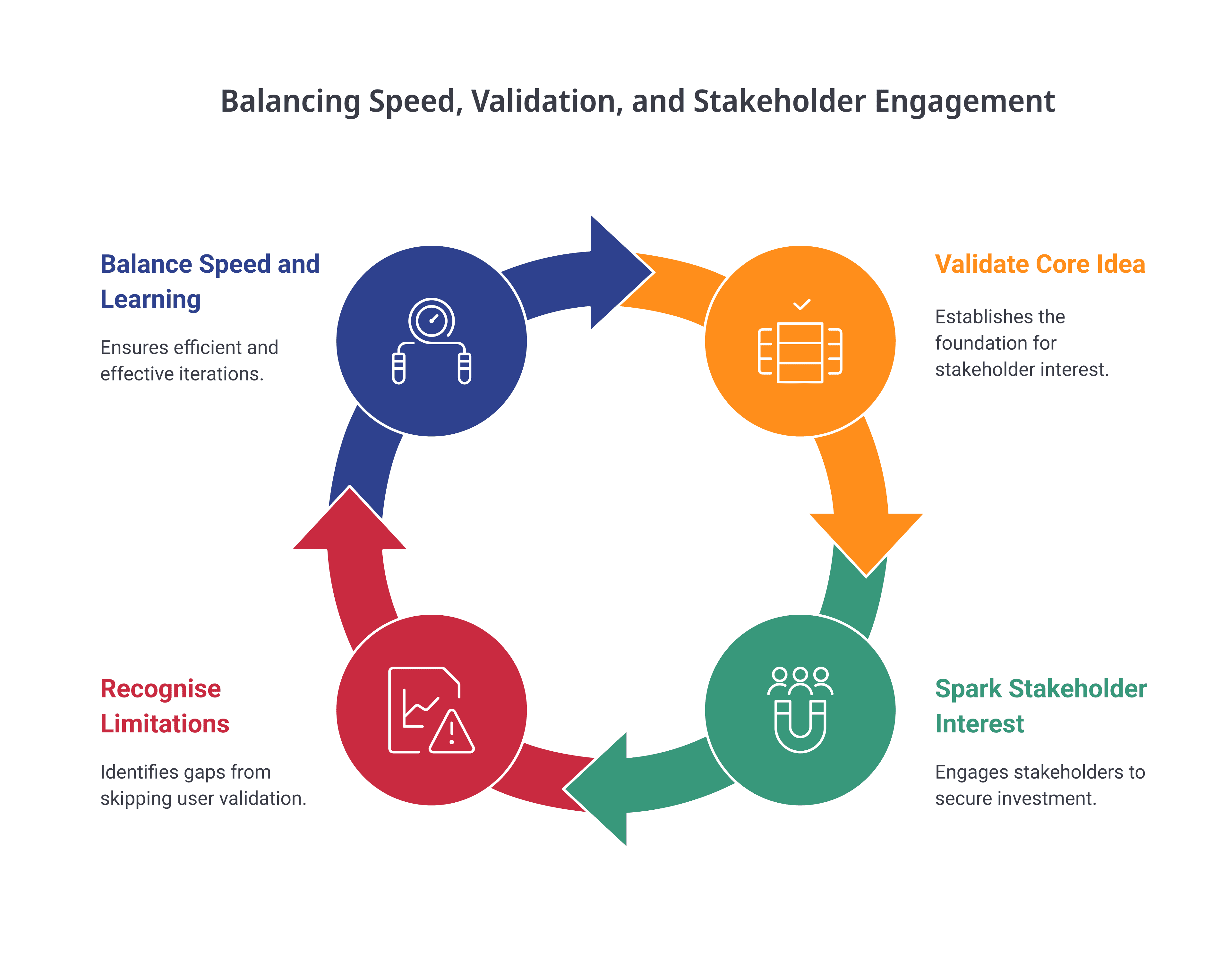
The launch did not lead to a second version of the same static roadmap. Feedback showed that people downloaded their plan but had little reason to return. The roadmap needed to behave like an evolving workspace, not a one-time answer—so we pivoted immediately toward an interactive, intelligent and adaptive experience.
Retention gap
A static download gave users no continuing reason to return or update their progress.
Data and model gap
Useful recommendations required more robust inputs, clearer uncertainty and stronger algorithms.
Validation gap
Speed created learning, but skipping deeper usability testing increased product risk.

Redefining the roadmap as an interactive experience
The next direction allowed users to track progress, edit tasks and goals, receive mentoring at relevant stages, and access curated learning resources—including Coursera content—inside the roadmap itself.
Interactive
Track progress, edit tasks and adapt goals as circumstances change.
Intelligent
Use richer role, skill and market inputs to create more relevant guidance.
Adaptive
Connect mentor support and learning resources to the right point in the journey.


The second roadmap concept turned the static output into a living career-development tool. Select the visual to inspect the full product design.
Designing trust and control into AI guidance
For an AI-generated career plan to be credible, users need to understand why a recommendation appears, change the inputs behind it and recover when the system is uncertain. The design therefore includes editable goals and skills, reasons behind suggestions, clear progress states and a safe fallback rather than hiding uncertainty behind a confident-looking answer.

Case-study trust concept based on Midshift’s visual language. The internal dashboard remains protected by the NDA.
10 · Pivoting Business Objectives
Evolving beyond AI roadmaps toward a broader career-development ecosystem
As we refined the second roadmap, stakeholder and market feedback exposed broader challenges in scalability, retention and engagement. The team therefore made a second, business-level pivot: mentorship would remain valuable, but as one part of an all-in-one career-development ecosystem rather than the product’s only centre.

Adaptive guidance
Extend the tested ML roadmap into a dynamic plan that responds to progress and learning milestones.
Holistic career support
Bring tutorials, planning tools, mentor support and relevant resources into one connected journey.
Complementary mentorship
Use mentors for targeted guidance alongside the roadmap rather than making every step depend on one-to-one support.
Community-driven growth hypothesis
Explore shared progress, reusable templates and co-created resources as a future research hypothesis.
A strategic hypothesis—not a finished product
This broader pivot lays the foundation for further research and iteration. It should be read as the next strategic direction, not as a shipped outcome or validated impact claim.
Project Reflection
What I learned from designing, shipping and changing direction
This project sharpened my ability to connect research, facilitation, rapid prototyping and product strategy. The most valuable lesson was that shipping quickly only creates value when the team is equally clear about what it needs to learn next.
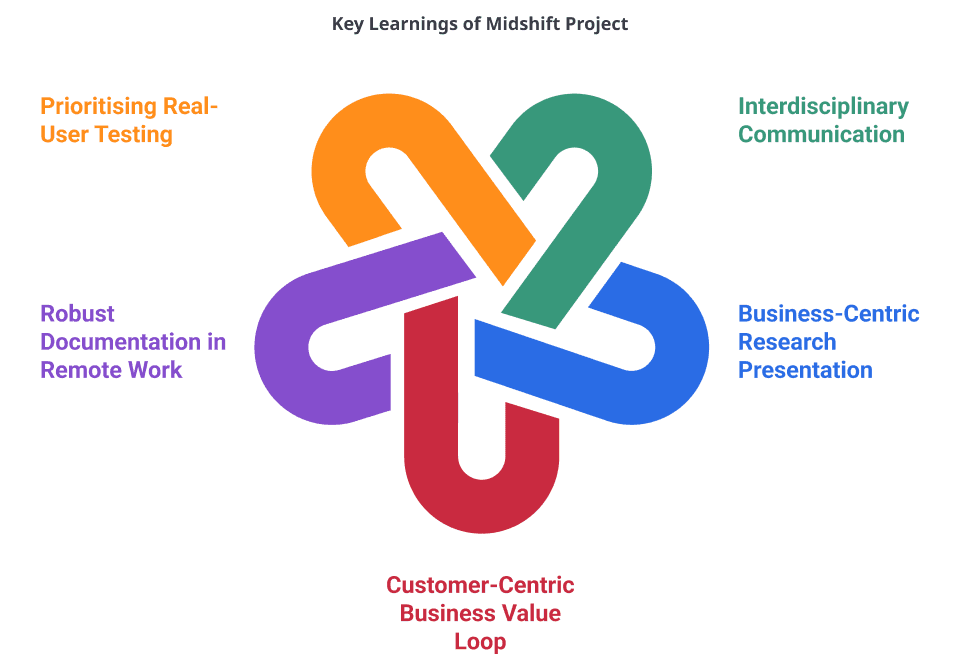
Interdisciplinary communication
Learn each discipline’s language and make decisions visible across product, UX, ML, engineering and marketing.
Business-centric research presentation
Translate research evidence into clear implications for feasibility, value, risk and scalability.
Customer-centric business value loop
Understand the value people receive and will invest in before optimising for revenue or investor narratives.
Robust remote documentation
Record decisions, trade-offs and meeting outcomes so the team can work coherently and onboard others.
Prioritising real-user testing
Even under pressure, test risky assumptions with real users before treating a fast release as product validation.
Ship to learn—but choose the learning goal first.
That principle now shapes how I scope MVPs, facilitate trade-offs and present evidence to stakeholders.
