[Case 01]
Research turned a mentorship concept into an AI roadmap product—then the shipped MVP exposed the need to pivot immediately.
EdTech · AI · Career development
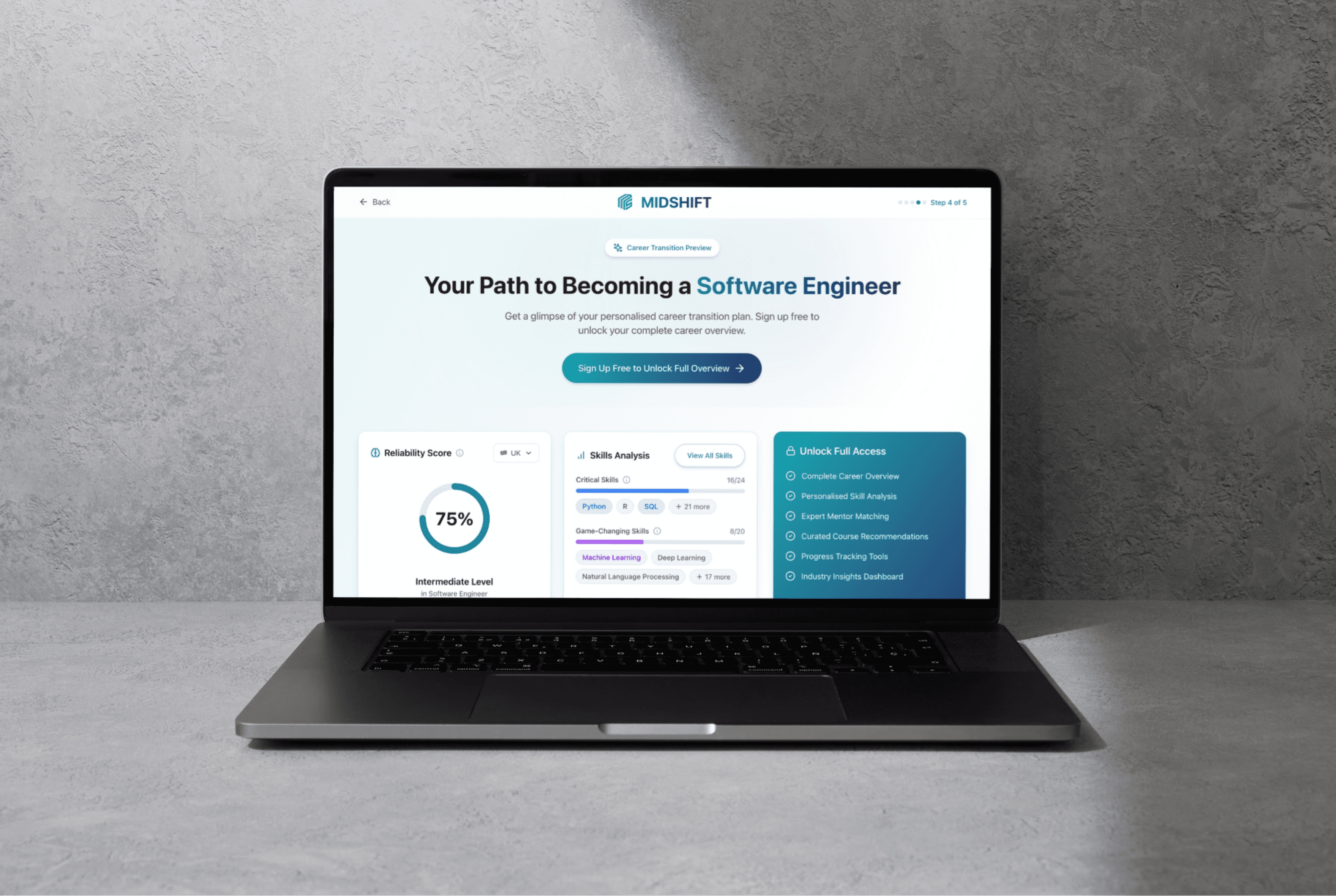
Reframing mentorship around a career roadmap people could act on
An 8-week product-design project that moved from research and workshop facilitation to a shipped MVP—and an immediate pivot.
[Project Overview]
Midshift began as a mentorship platform. Research showed that the more urgent problem was helping people understand what to do next, so the team reframed the product around a personalised AI career roadmap. We scoped and shipped a deliberately focused MVP, then pivoted immediately when the release exposed that a static roadmap could not support an ongoing career-development journey.
[Problem Statement]
Mentorship wasn't broken. Knowing what to do next was. We interviewed mentees and mentors on existing platforms and the same thing surfaced on both sides. Mentees couldn't tell which skills to prioritise, so they stalled. Mentors burned hours just working out where someone was before they could give useful advice. The matching wasn't the issue. The guidance was missing.
[Industry]
EdTech · AI · Career development
[My Role]
Product Designer · Workshop Facilitator
[Platforms]
Responsive web app
[Timeline]
8 weeks
[Persona]

Sahar (representative persona)
Mid-level marketer
I've been stuck in the same role for years because I don't know which skills to prioritise.
Age: 31
Location: UK
Tech Proficiency: High
Gender: Female
[Goal]
Know which skills to build next, in order.
See whether the effort is moving her toward a senior role.
Get real guidance without booking a mentor every time.
[Frustrations]
Generic courses that give content but no personal feedback.
No sense of progress, so motivation drains.
Every mentor spends the first session working out where she's starting from.
[Process]
[01] User Research
Interviewed mentees and mentors using existing mentorship platforms.
Co-ran ideation workshops to pressure-test what we were hearing.
Benchmarked competitors across EdTech to see what was already solved.
[02] Insights
The gap was guidance, not matching. People stalled because they couldn't prioritise.
Mentees wanted a clear next step, not a longer list of options.
Mentors lost time locating each person's starting point before any real advice.
[03 Design Solution]
Reframed the product around an AI roadmap: read current skills, compare against thousands of real senior career paths, lay out the next steps.
Designed the core flows and the rapid prototypes we put in front of users.
Built the Figma design system from scratch, then moved into build-and-iterate cycles in Bolt.new and Cursor.
[04] Testing & Iteration
Shipped a focused MVP to test whether people understood and valued an AI-generated career roadmap.
Reviewed the first release and identified that a one-time static roadmap did not create the continuing value the product needed.
Pivoted immediately toward an interactive experience with editable goals, visible progress, mentor support, and relevant learning resources.
[Outcome]
Shipped the first AI career-roadmap MVP within the eight-week project.
The release challenged the static-roadmap assumption and made the retention risk visible.
The team pivoted immediately toward a broader, interactive career-development experience.
[Key Learnings]
Ship to learn, but choose what to learn first
Releasing the focused MVP made the central assumption testable and gave the team a concrete reason to change direction.
A one-time answer won't retain anyone
A static roadmap was useful as an answer, but not sufficient as an ongoing product experience.
Design the AI states, not just the happy path
Trust depends on showing inputs, uncertainty, editable recommendations, and useful states beyond the happy path.